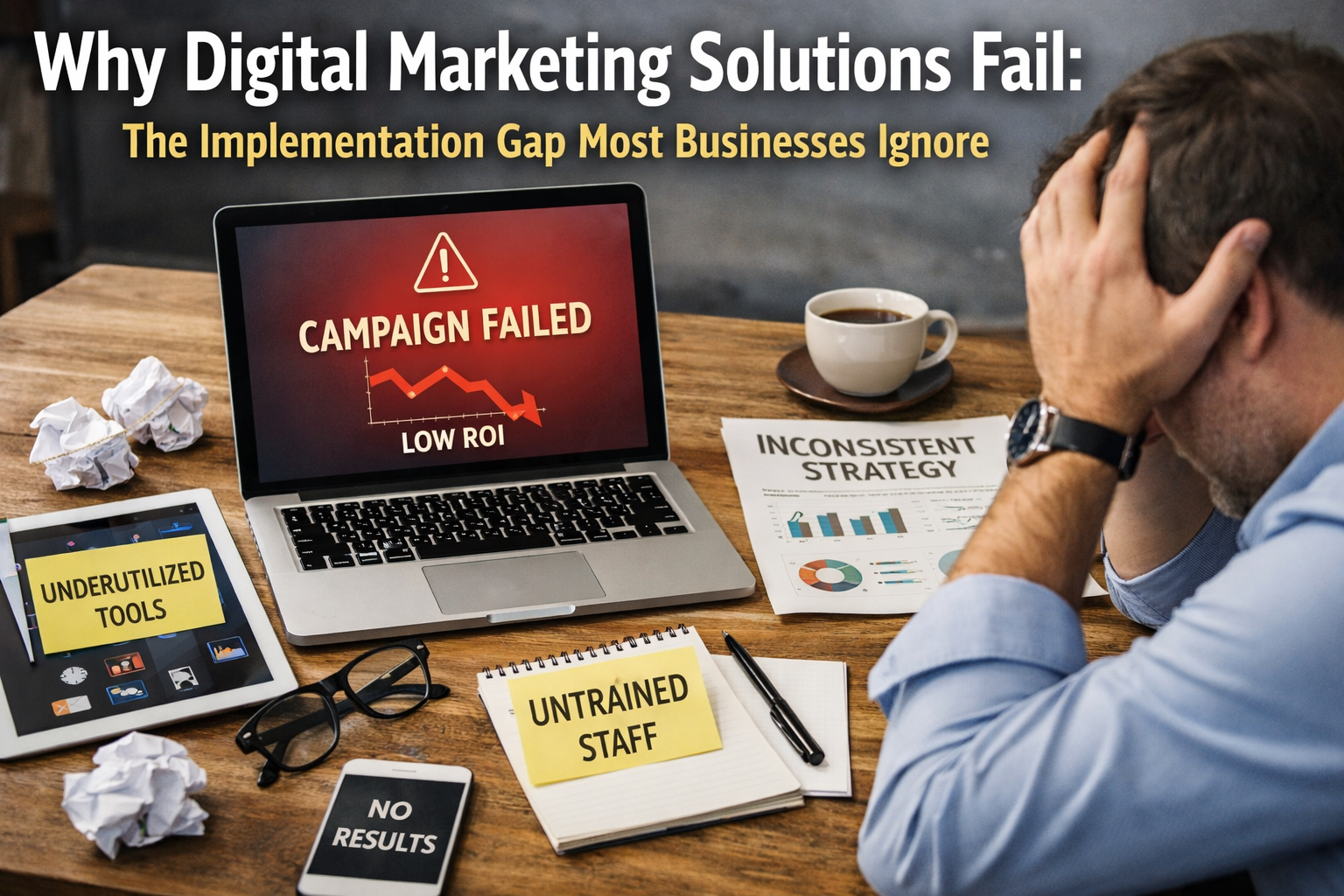
Most businesses don’t fail because they chose the “wrong” channel. They fail because there’s a gap between what’s planned on paper and what actually gets executed day to day. That space between strategy and consistent implementation is where promising campaigns quietly die.
On the surface, it’s easy to blame the platform (“Google Ads don’t work for us”), the industry (“our niche is too competitive”) or the economy. But if you look closely at campaigns that perform versus those that stall, the difference is rarely the idea itself. It’s the follow-through.
This implementation gap is especially visible in competitive markets where many businesses invest in digital marketing services in Melbourne, yet only a handful consistently see strong, compounding results.
The Implementation Gap: Great Plans, Weak Follow-Through
Most businesses don’t have a strategy problem. They’ve had audits, brainstorms, workshops and slide decks. They know, broadly, what they should be doing: better content, improved SEO, smarter ad targeting, cleaner tracking, stronger landing pages.
Where things break down is after the initial excitement:
- Campaigns are launched but never properly optimised
- Content calendars are created but not followed
- Tracking is set up once but never checked or cleaned
- Teams get busy and “we’ll update that later” quietly becomes “never”
The result is a digital presence that looks active on the surface but isn’t actually improving month after month. Spending continues, but learnings don’t compound.
Misaligned Expectations: Strategy as an Event, Not a Process
One of the biggest reasons implementations fail is how business owners think about “solutions”. Many treat digital marketing like a project with a fixed endpoint: launch the new website, push a few campaigns, write a handful of blogs, then expect the results to roll in on autopilot.
In reality, every channel—SEO, paid ads, email, social—requires:
- Iteration based on performance
- Adjustments as competitors respond
- Adaptation to algorithm changes and market shifts
If a business sees strategy as a one-off event rather than an ongoing process, implementation will always lag. You can’t optimise what you aren’t actively monitoring and adjusting.
Too Many Tools, Not Enough Ownership
Modern marketing stacks are full of software: CRMs, automation tools, analytics platforms, heatmap tools, SEO suites, reporting dashboards. On their own, they’re impressive. Together, they often create noise.
The issue isn’t the tools; it’s the lack of clear ownership. No one is truly responsible for making sure:
- Data is accurate
- Tools are talking to each other
- Insights from reports actually lead to action
This is where a focused partner, such as A.P. Web Solutions, can make a difference—by turning scattered tools and “nice-to-have” dashboards into a coherent system that supports decision-making instead of overwhelming it.
Fragmented Providers, Fragmented Results
Another common implementation gap appears when different providers handle different pieces with no central strategy:
- One agency runs Google Ads
- Another builds the website
- A freelancer writes blogs
- An internal staff member “handles social” on the side
Each party may do reasonable work in their lane, but no one is responsible for tying everything together. Landing pages don’t match ad messages, content doesn’t support SEO priorities, and social posts don’t feed into retargeting or email flows.
On paper, the business is paying for a full stack of digital marketing solutions. In reality, those pieces are working in parallel, not together, so the overall performance never reaches its potential.
No Clear KPIs or Feedback Loops
You can’t implement effectively if you don’t know what “good” looks like.
Too often, campaigns are measured only by surface metrics—clicks, impressions, likes—without a clear connection to leads, sales or revenue. When that happens, implementation becomes aimless: tasks get done, but no one is sure which ones truly matter.
Strong implementation needs:
- A small set of core KPIs tied to business outcomes
- Consistent reporting at agreed intervals
- Decisions made from that data (pause, scale, test something new)
Without this rhythm, marketing activity drifts back into “set and forget” mode, and the gap widens between what was promised at the proposal stage and what’s actually delivered.
Underestimating Content and Offer Quality
Even with the right channels, tools and reporting, implementation will still fail if the content and offers aren’t compelling.
Common problems include:
- Generic landing pages that don’t speak to a specific audience
- Weak calls to action that ask too much, too soon
- Blogs written for keywords but not for real readers
- Lead magnets or offers that don’t solve a meaningful problem
Execution isn’t just about doing more—it’s about doing the right things well. Often, a smaller number of high-quality, strategically aligned assets will outperform a large volume of rushed, generic content.
How to Close the Implementation Gap
Closing the gap doesn’t require reinventing your entire marketing strategy. It requires tightening the link between planning and execution.
Practical steps include:
- Assigning clear ownership for each channel and tool
- Agreeing on a realistic implementation timeline (not everything at once)
- Setting up simple, reliable reporting that everyone understands
- Running regular review cycles to decide what to keep, fix or drop
- Treating campaigns as ongoing experiments rather than one-off tasks
Over time, this approach shifts your digital marketing from a series of disconnected actions into a compounding system—small improvements, made consistently, that add up to significant performance gains.
Final Thoughts
Most digital marketing underperforms not because the ideas are bad, but because execution is inconsistent, fragmented or rushed. The businesses that win are rarely the ones with the fanciest presentations; they’re the ones that show up every month, tighten the screws, and keep closing the gap between strategy and implementation.
If you can build or partner into a system that does that—bringing together channels, tools, content and reporting under one clear direction—your digital marketing stops being a gamble and becomes a reliable, scalable growth engine for your business.