Some people save engagement ring photos for years.
Others start shopping and discover within ten minutes that they have absolutely no idea what they like.
“I want something simple.”
Then they save a sapphire halo.
“I definitely want a diamond.”
Then they discover moss agate.
“I don’t like vintage rings.”
Twenty minutes later, they’re looking at milgrain.
This is completely normal. Engagement rings cover a much broader design spectrum than the traditional diamond solitaire. Today’s choices range from classic solitaires and three-stone rings to colored gemstones, vintage-inspired settings, nature-inspired designs, and unconventional shapes.
Understanding these main styles makes it much easier to identify what actually feels right.
What Are the Main Engagement Ring Styles?
Engagement rings can be categorized in a few different ways, including by setting, gemstone, design period, overall aesthetic, or how much customization is involved.
Some of the main engagement ring styles include solitaire, halo, three-stone, minimalist, modern, vintage-inspired, gemstone, nature-inspired, unconventional, and custom designs.
The fun part is that these categories aren’t strict. A ring can easily fit into more than one style. You could have a vintage-inspired sapphire engagement ring, a minimalist gemstone solitaire, or a nature-inspired moss agate design.
It’s more helpful to think of engagement ring styles as ingredients you can mix together rather than a set of rigid categories. That gives you a lot more freedom to find a ring that actually feels like your style.
1. Solitaire Engagement Rings: The Classic Starting Point
A solitaire features one primary center stone without a surrounding halo or prominent side stones.
It’s one of the most recognizable engagement ring designs because the structure is simple and the gemstone receives most of the attention.
Popular solitaire stone shapes include:
- Round
- Oval
- Pear
- Marquise
- Cushion
- Emerald cut
- Radiant
Solitaire settings can also make choosing a wedding band relatively straightforward because fewer decorative elements compete with the second ring.
Who Does a Solitaire Suit?
A solitaire engagement ring can be a great fit for someone who prefers clean designs, classic jewelry, minimal decoration, or a center stone that gets most of the attention. The simple setting can also make it easier to pair the ring with different wedding bands.
But solitaire doesn’t automatically mean traditional.
Put a hexagonal sapphire or pear-shaped tourmaline into a simple solitaire setting and the whole ring can feel much more unexpected. Sometimes the gemstone itself is enough to give a familiar setting a completely different personality.
2. Halo Engagement Rings: More Detail Around the Center Stone
A halo engagement ring surrounds the center gemstone with smaller diamonds or other accent stones. The extra stones add sparkle and create a defined frame around the center.
And halos don’t all have to look the same. You can find round, oval, geometric, floral, vintage-inspired, and even asymmetrical halo designs.
A diamond halo around a colored gemstone can be especially nice because the diamonds create contrast while letting the center stone’s color stand out. It’s a good option if you want the sparkle of a traditional engagement ring but still want to make the center gemstone feel more personal.
Who Is a Halo Engagement Ring Best For?
A halo engagement ring can be a good choice if you like extra sparkle, decorative settings, or a ring with a little more visual presence.
It’s also a natural fit for someone who gravitates toward vintage-inspired jewelry or likes the contrast between a center gemstone and smaller accent stones.
The nice thing about halo settings is that they can be as subtle or as detailed as you want. A delicate halo can simply add a little extra sparkle around the center stone, while a larger or more decorative design can make the entire ring feel more elaborate.
3. Three-Stone Engagement Rings: A Symbolic Classic
Three-stone engagement rings feature a center gemstone with two smaller stones on either side. The three stones are often associated with a relationship’s past, present, and future, which gives the setting a sentimental meaning without making the design feel overly complicated.
From a design perspective, three-stone rings also give you more freedom to mix gemstones and shapes. You could pair a sapphire center with diamonds, use an emerald with diamond side stones, or even combine three different colored gemstones.
That’s what makes this style so versatile. A three-stone engagement ring can feel very traditional with classic diamonds, or completely different with unexpected gemstones and color combinations.
4. Minimalist Engagement Rings: Less Detail, More Focus
Minimalist engagement rings keep the focus on the gemstone, proportions, and overall shape rather than adding lots of decorative details.
You’ll often see simple bands, solitaire or bezel settings, small accent stones, clean geometric shapes, and lower-profile designs.
Minimalist doesn’t necessarily mean small. A substantial oval gemstone in a simple setting can still have a minimalist look.
The key is restraint. It’s less about the size of the ring and more about keeping the design intentional without adding details that don’t need to be there.
Who Does a Minimalist Ring Suit?
Who Is a Minimalist Engagement Ring Best For?
A minimalist engagement ring can make sense for someone whose existing jewelry tends to be simple, understated, geometric, and easy to mix and match.
If she doesn’t usually wear a lot of decorative detail, a clean engagement ring will probably feel more natural with the rest of her jewelry.
That doesn’t mean the ring has to be boring. A distinctive center gemstone can add plenty of personality while keeping the overall design simple and easy to wear.
5. Modern Engagement Rings: Familiar Ideas With a Different Approach
Modern engagement ring design often takes familiar jewelry elements and changes the proportions, orientation, or overall composition.
You might see an east-west setting, a bezel-set gemstone, a geometric center stone, an asymmetrical band, mixed metals, unusual side stones, or intentional negative space.
An emerald-cut gemstone set horizontally instead of vertically is a simple example. The stone itself is familiar, but changing its orientation gives the entire ring a different look.
This is what makes modern engagement rings a good option for someone who wants something distinctive without moving too far away from the familiar shapes and proportions of fine jewelry.
6. Vintage-Inspired Engagement Rings: Detail With Historical Influence
Vintage-inspired engagement rings borrow design details from jewelry styles of earlier periods without necessarily being antique pieces.
You might see milgrain, filigree, decorative bands, intricate halos, geometric arrangements, floral motifs, or more detailed stone settings.
Colored gemstones can work especially well with this style. A sapphire, emerald, opal, or another gemstone can completely change the feel of a vintage-inspired setting while still keeping those recognizable old-world details.
It’s a good option if you love the look of antique jewelry but want something newly made that can be customized to your preferences.
Vintage vs Vintage-Inspired
These terms aren’t identical.
A vintage ring is an older piece from a previous period.
A vintage-inspired ring is newly produced using design elements influenced by older jewelry.
The second option can provide more flexibility with gemstone choice, sizing, precious metal, and customization.
7. Gemstone Engagement Rings: Color Becomes Part of the Design
Diamonds aren’t required for engagement rings.
Colored gemstones can completely change the visual identity of otherwise familiar designs.
When browsing engagement rings, buyers can consider both traditional diamonds and alternative gemstones according to color preference, durability, symbolism, and personal style.
Popular choices include:
Sapphire
Sapphires are available in blue, teal, green, pink, yellow, peach, and parti-color varieties.
With a Mohs hardness of 9, sapphire is also well suited to frequent wear.
Emerald
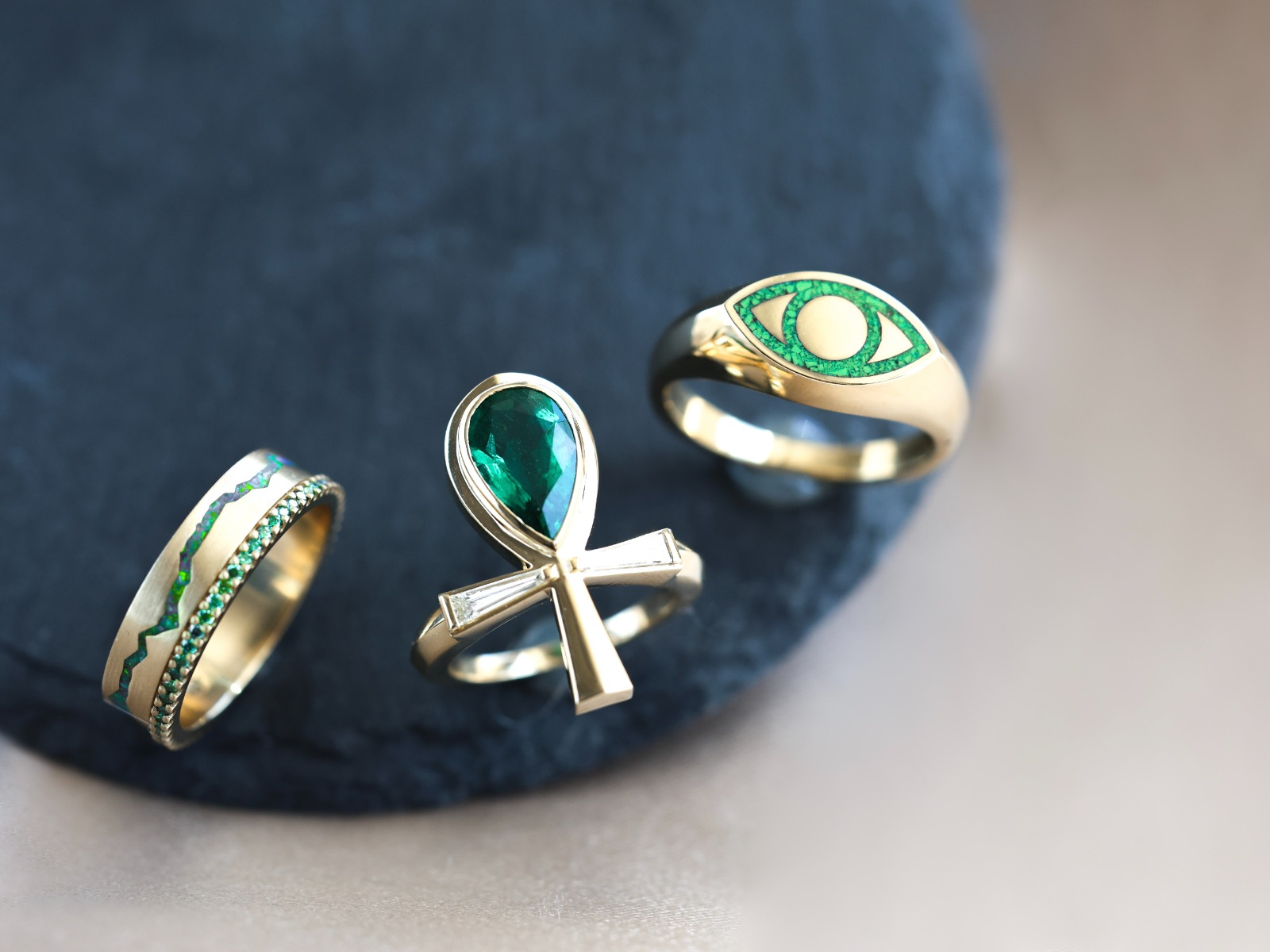
Emerald creates a recognizable green center stone and works with classic, vintage-inspired, geometric, and nature-inspired settings.
Alexandrite
Alexandrite is known for changing appearance under different lighting conditions.
That color-change characteristic can make the gemstone particularly appealing for unconventional engagement jewelry.
Opal
Opal displays play-of-color, producing shifting flashes as the gemstone or viewing angle changes.
It is softer than diamond or sapphire and therefore requires more thoughtful everyday care.
Moss Agate
Moss agate contains natural inclusions that can resemble branches, moss, or miniature landscapes.
The pattern differs from stone to stone, making natural variation part of the design.
Tourmaline
Tourmaline offers an unusually broad range of colors, including pink, green, blue, peach, and bi-color combinations.
This makes it particularly useful for highly personalized color-based designs.
For independent gemstone education, the Gemological Institute of America (GIA) provides information about diamonds and colored gemstones, including their characteristics and care.
8. Nature-Inspired Engagement Rings: Botanical and Organic Details
Not every ring needs perfect symmetry and straight lines.
Nature-inspired engagement rings incorporate elements such as:
- Leaves
- Branches
- Flowers
- Vines
- Organic curves
- Natural textures
Gemstone choice can reinforce this aesthetic.
Moss agate is an obvious example because its inclusions can resemble vegetation.
Emerald, green sapphire, and green tourmaline can also connect the design to nature through color rather than literal botanical details.
Who Does a Nature-Inspired Ring Suit?
Nature-inspired engagement rings can be a great fit for someone who naturally gravitates toward botanical jewelry, outdoor spaces, organic shapes, or a more bohemian aesthetic.
They’re also a nice option if she likes gemstones that already have a naturally individual appearance.
The nature reference doesn’t have to be obvious, either. A ring might feature detailed leaves and branches, or it could be as subtle as a softly curved band or a gemstone with earthy colors. The idea is to bring a little bit of the natural world into the design without making the ring feel overly themed.
9. Unconventional Engagement Rings: When Traditional Rules Don’t Fit
Some people look at a traditional engagement ring and think, “Beautiful. Just not me.”
That’s exactly where unconventional engagement rings come in. They give you room to move away from familiar bridal designs without having to choose something completely over the top.
Alternative engagement rings might feature kite-shaped or hexagonal gemstones, asymmetrical arrangements, east-west settings, salt-and-pepper diamonds, colored center stones, mixed gemstones, or unusual clusters.
And unconventional doesn’t have to mean strange. Sometimes one unexpected detail is enough to make a ring feel completely different from conventional bridal jewelry.
A classic gold band with a bi-color tourmaline, for example, can still look simple and easy to wear while giving the ring a much more individual feel.
10. Colored Gemstones vs Diamonds
This isn’t necessarily an either-or decision.
Colored gemstones and diamonds can work together.
A sapphire center stone might have diamond side stones.
An opal might be surrounded by a diamond halo.
A tourmaline could be combined with small pavé diamonds.
Diamonds provide brilliance and a neutral appearance, while colored gemstones introduce another visual dimension.
The combination can preserve familiar bridal elements without requiring a traditional colorless center stone.
11. Match the Engagement Ring to Personality
Personal style is often a better starting point than trends.
For the Classic Personality
Consider:
- Solitaire
- Round or oval stone
- Diamond
- Three-stone setting
For the Minimalist
Consider:
- Bezel setting
- Simple solitaire
- Clean band
- Emerald-cut stone
For the Vintage Lover
Consider:
- Milgrain
- Filigree
- Decorative halo
- Sapphire or emerald
For the Nature Lover
Consider:
- Moss agate
- Green gemstones
- Leaf details
- Organic settings
For the Color Lover
Consider:
- Sapphire
- Tourmaline
- Emerald
- Alexandrite
- Opal
For the Non-Traditional Personality
Consider:
- Geometric gemstones
- Asymmetry
- Mixed stones
- Unusual orientations
These are starting points rather than rules.
Someone can love minimalist clothing and still want an enormous pink gemstone.
Humans remain inconveniently difficult to categorize.
12. Lifestyle Should Influence Style
Looks aren’t the only thing to think about when choosing an engagement ring. If the ring is going to be worn almost every day, it needs to make sense for the person’s actual routine too.
Someone with an active lifestyle may be better suited to a lower setting, secure stone placement, a durable gemstone, and a design without too many exposed details.
If she already takes her jewelry off for workouts, physical work, or other activities, you may have more flexibility when choosing the design.
Gemstone choice matters here as well. Diamond ranks 10 on the Mohs hardness scale, while sapphire ranks 9. Softer gemstones such as opal require a little more care if they’re going to be worn frequently.
The best engagement ring isn’t just one that looks good. It should also feel like something she can realistically live with every day.
13. Choose the Right Metal
Metal changes the overall appearance of an engagement ring.
Common options include:
Yellow Gold
Creates a warmer appearance and pairs well with diamonds and many colored gemstones.
White Gold
Provides a neutral white-metal appearance that works across classic and modern designs.
Rose Gold
Adds a warmer pink tone and is often used with romantic or vintage-inspired designs.
Platinum
Naturally white and dense, platinum is another established choice for engagement rings.
Looking at the jewelry someone already wears can provide a useful clue.
If almost everything in their jewelry box is yellow gold, there’s probably no need to turn the engagement ring decision into a metal-color experiment.
14. When Does a Custom Engagement Ring Make Sense?
Sometimes you look through every engagement ring style and still can’t find one that feels quite right.
Maybe you want a teal sapphire with a vintage setting, a nature-inspired band, and yellow gold. That’s a pretty specific combination, and it may not exist as a ready-made ring.
That’s where customization can make a difference.
Depending on the jeweler, you may be able to choose the center gemstone, stone shape, precious metal, accent stones, setting, band width, engraving, and even smaller hidden details.
The biggest advantage of a custom engagement ring is that you don’t have to choose just one style. You can mix different design ideas together and create a ring that feels much more personal than something selected from a predefined collection.
A Quick Engagement Ring Style Guide
| Style | Main Characteristics | May Suit Someone Who Likes |
| Solitaire | Single center stone | Classic, clean designs |
| Halo | Accent stones around center | Sparkle and detail |
| Three-stone | Center plus two side stones | Symbolism and balance |
| Minimalist | Simple lines, fewer details | Understated jewelry |
| Modern | Geometry, unusual orientation | Contemporary design |
| Vintage-inspired | Milgrain, filigree, detail | Historical aesthetics |
| Gemstone | Colored center stone | Color and individuality |
| Nature-inspired | Leaves, vines, organic forms | Botanical design |
| Unconventional | Asymmetry, unusual stones | Non-traditional jewelry |
| Custom | Personalized combination | Highly specific preferences |
Frequently Asked Questions
What are the main styles of engagement rings?
Common engagement ring styles include solitaire, halo, three-stone, minimalist, modern, vintage-inspired, gemstone, nature-inspired, unconventional, and custom designs. Many rings combine characteristics from several categories.
What is the most timeless engagement ring style?
A solitaire is generally considered one of the most enduring engagement ring designs because of its simple structure and focus on a single center stone. However, “timeless” ultimately depends on personal style rather than one specific design.
What are good alternatives to traditional diamond engagement rings?
Sapphire, emerald, alexandrite, opal, moss agate, and tourmaline can all be used for alternative engagement rings. Durability, setting, maintenance, and lifestyle should be considered when choosing a colored gemstone.
What makes an engagement ring unconventional?
Unconventional engagement rings may use colored gemstones, unusual shapes, asymmetric settings, east-west orientations, mixed gemstones, salt-and-pepper diamonds, or other elements outside conventional bridal design.
How do I know which engagement ring style is right?
Start with the wearer’s existing jewelry, personality, preferred colors, lifestyle, and attitude toward traditional design. Then narrow the options by gemstone, setting, metal, and desired level of customization.
Final Thoughts
Engagement ring style is no longer a choice between “traditional diamond” and “something unusual.”
There’s an entire spectrum in between.
A solitaire can be traditional with a round diamond or unconventional with a geometric sapphire. A vintage-inspired ring can feature classic diamonds or a colored center stone. A minimalist design can still make a strong statement when the gemstone itself is unusual.
That’s why choosing an engagement ring becomes easier when you stop trying to identify the single best style.
Instead, identify the elements that matter to the person wearing it: color, simplicity, symbolism, history, nature, individuality, or tradition.
Then build the ring around those preferences.
Because the most useful engagement ring category isn’t “classic” or “alternative.”
It’s the one they’ll actually want to wear.